
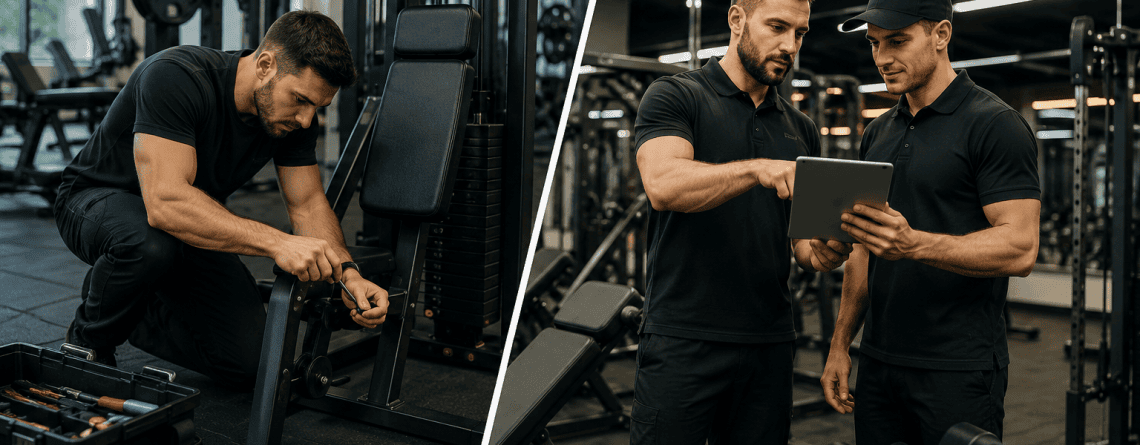
In-House vs Outsourced Equipment Maintenance: Which Strategy Is Right for Your Facility?
Every facility manager eventually faces the same question: should equipment maintenance be handled by an internal team, or is it smarter to bring in outside experts? Choosing between in-house vs outsourced equipment maintenance is one of the most important operational decisions a business can make, and getting it wrong can mean costly downtime, safety risks, and wasted budget.
For gyms, hotels, hospitals, and commercial facilities across Qatar, fitness and mechanical equipment represents a major investment. Whether it’s a full commercial gym setup or a single treadmill fleet, keeping equipment running smoothly requires a clear maintenance strategy. In this guide, we break down the equipment maintenance outsourcing pros and cons, the real cost of building an internal team, and how to decide what works best for your facility.
What Is In-House Equipment Maintenance?
In-house maintenance means hiring, training, and managing your own technicians to service equipment on-site. This model gives facility managers direct control over scheduling, response times, and quality standards.
However, the in-house maintenance team cost goes far beyond salaries. It includes:
- Recruitment and onboarding expenses
- Ongoing technical training and certifications
- Specialized tools and diagnostic equipment
- Spare parts inventory and storage
- Employee benefits, insurance, and overtime pay
For facilities with large or complex equipment fleets — such as commercial gyms with cardio, strength, and aqua fitness machines — an internal team can offer faster response times. But smaller facilities often find the fixed overhead difficult to justify.
What Is Outsourced Equipment Maintenance?
Outsourcing means partnering with a specialized third-party maintenance provider who handles servicing, repairs, and preventive maintenance under a contract. This is one of the fastest-growing trends in facility management because it converts unpredictable repair costs into a predictable, scheduled expense.
Key outsourced maintenance services benefits include:
- Access to certified specialists without hiring full-time staff
- Manufacturer-trained technicians for specific equipment brands
- Reduced liability and compliance risk
- Scalable service agreements that grow with your facility
- No investment in specialized tools or ongoing training
Many gyms and hotels in Qatar rely on third-party maintenance providers precisely because equipment brands like treadmills, cross trainers, and strength machines require brand-specific expertise that’s expensive to maintain internally.
Equipment Maintenance Strategy Comparison: Key Factors to Consider
When comparing maintenance outsourcing vs in-house staff, evaluate these five factors:
1. Cost Structure
In-house maintenance involves fixed costs (salaries, benefits, training) regardless of how much work is actually needed. Outsourcing shifts this to variable, contract-based pricing, which is often more predictable for budgeting.
2. Equipment Uptime and Response Time
An equipment uptime maintenance strategy should prioritize minimizing downtime. In-house teams can respond instantly since they’re on-site, but outsourced providers with strong SLAs (Service Level Agreements) can offer guaranteed response windows and priority scheduling.
3. Technical Expertise
Modern gym and industrial equipment is increasingly complex, with digital consoles, sensors, and proprietary parts. Industrial equipment maintenance solutions from authorized dealers ensure technicians are trained directly by manufacturers, something small internal teams struggle to match.
4. Scalability
Facilities expanding into new locations benefit from outsourcing because service contracts can scale without the need to hire and train new staff at every site.
5. Compliance and Warranty Protection
Using unauthorized technicians can void manufacturer warranties. Working with certified providers protects your investment and keeps warranty coverage intact — something worth checking before choosing either model.
Cost of In-House Equipment Maintenance vs Outsourcing: A Side-by-Side Look
The true cost of in-house equipment maintenance often surprises facility owners once hidden expenses are added up. Here’s a simplified comparison:
In-House Maintenance Costs:
- Fixed salaries and benefits year-round
- Continuous training as equipment technology evolves
- Idle labor cost during low-maintenance periods
- Full responsibility for tools, parts, and inventory
Outsourced Maintenance Costs:
- Pay-per-service or fixed contract pricing
- No idle labor cost
- Access to shared expertise across multiple equipment brands
- Built-in accountability through service agreements
For facilities with fewer than 50 pieces of equipment, outsourcing is typically more cost-effective. Larger facilities with 24/7 operational demands may find a hybrid model — a small internal team supported by an outsourced specialist — works best.
Preventive Maintenance Outsourcing: Why It’s Gaining Popularity
Preventive maintenance outsourcing has become a preferred model because it shifts the focus from reactive repairs to scheduled inspections that catch problems early. This approach:
- Extends equipment lifespan
- Reduces emergency repair costs
- Improves safety for gym members and staff
- Maintains consistent equipment performance
This is especially relevant for facility maintenance in-house vs contracted decisions in commercial gyms, hotels, and hospitality settings, where equipment downtime directly affects customer experience and revenue.
CMMS in-House Maintenance Planning: Bridging the Gap
Some facilities choose a middle-ground approach using CMMS (Computerized Maintenance Management System) software to manage in-house maintenance planning more efficiently. This allows internal teams to:
- Track maintenance schedules digitally
- Log equipment history and part replacements
- Set automated reminders for servicing
- Reduce paperwork and manual tracking errors
A CMMS system can make an in-house team significantly more efficient, closing some of the cost gap with outsourced providers.
Reliability Centered Maintenance Outsourcing: A Strategic Approach
Reliability centered maintenance outsourcing focuses on maintaining the equipment that matters most to daily operations, rather than treating all machines equally. For a commercial gym, this might mean prioritizing high-use cardio equipment and strength machines over rarely-used accessories.
This strategic model works well when paired with an experienced supplier who understands equipment usage patterns — something Sports Village Qatar applies across its commercial gym equipment installations throughout Doha.
Maintenance Staffing vs Contracting: How to Decide
There’s no universal answer for maintenance staffing vs contracting — the right choice depends on your facility type, equipment volume, and budget. Use this quick decision framework:
Choose In-House If:
- You operate a large facility with high daily equipment usage
- You need instant, on-site response at all times
- You have the budget for full-time technical staff
Choose Outsourcing If:
- You want predictable maintenance costs
- You need access to brand-certified technicians
- You’re managing multiple locations or a smaller facility
- You want to reduce management overhead
Many hotels, hospitals, and gyms across Qatar — including several projects completed by Sports Village Qatar — rely on outsourced after-sales gym equipment support to keep their fitness centers running without the burden of managing full-time maintenance staff.
Maintenance Management Decision Guide: Questions to Ask Before Choosing
Before finalizing your maintenance management decision guide, ask:
- How many pieces of equipment need regular servicing?
- What is our acceptable downtime threshold?
- Do we have in-house technical expertise for our specific equipment brands?
- What does our warranty require regarding authorized service providers?
- What is our annual maintenance budget, and how predictable does it need to be?
Answering these honestly will clarify whether an internal team, an outsourced partner, or a hybrid model fits your facility best.
How Sports Village Qatar Supports Both Maintenance Models
Whether you’re building an in-house team or looking for a trusted outsourced partner, having the right equipment supplier matters. Sports Village Qatar has supplied and maintained fitness equipment across Qatar since 2006, working with hotels, gyms, and commercial facilities throughout Doha.
Our team offers full after-sales technical support, genuine spare parts, and manufacturer-trained servicing for commercial gym equipment and home gym equipment, so facilities don’t have to choose between quality and convenience.
We’ve also supported large-scale institutions such as Qatar University and leading hotel chains with ongoing equipment maintenance, giving us direct insight into what works for different facility sizes.
Frequently Asked Questions
Is outsourced equipment maintenance cheaper than in-house maintenance?
In most cases, yes — especially for small to mid-size facilities. Outsourcing removes fixed labor costs and replaces them with predictable contract pricing, though very large facilities with constant maintenance needs may find in-house staffing more cost-efficient long term.
Does outsourcing maintenance void equipment warranties?
No, as long as you use an authorized or manufacturer-approved service provider. Using unauthorized or unqualified technicians is what typically voids warranty coverage.
Can a facility use both in-house and outsourced maintenance together?
Yes. Many facilities use a hybrid model — an internal team handles daily checks and minor tasks, while an outsourced provider manages specialized repairs, parts replacement, and preventive servicing.
How often should commercial gym equipment be serviced?
Most commercial equipment requires preventive maintenance every 1 to 3 months, depending on usage frequency, though high-traffic cardio machines may need more frequent checks.
What should I look for in a maintenance outsourcing provider?
Look for manufacturer authorization, certified technicians, transparent service agreements, spare parts availability, and a proven track record with similar facilities in your region.
Final Thoughts
Deciding between in-house vs outsourced equipment maintenance isn’t just about cost — it’s about protecting your equipment investment, ensuring member and staff safety, and keeping operations running smoothly. Whether you choose an internal team, an outsourced partner, or a hybrid approach, the right strategy should match your facility’s size, budget, and daily equipment demands.
If you’re unsure which maintenance model fits your facility, our team at Sports Village Qatar can help you evaluate your equipment needs and recommend the right support plan.
Ready to protect your equipment investment? explore our full range of commercial and home fitness solutions, or contact us today for a free maintenance consultation.




LEAVE A COMMENT